Connect with Me

Monday, January 25, 2010

The Ultimate Competitive Advantage

image Why did it take until 1946 for the first computer to be invented?  All of the elements were in place by 1918.  It’s not because there weren’t companies capable of creating the computer.   In fact in the late 1800’s over 1000 electrical apparatus companies were formed to build electric devices.  

6 elements of knowledge need to create the computer

  1. binary arithmetic (Chinese scholar and philosopher Shao Yong in the 11th century)
  2. Charles Babbage’s calculating machine (est. 1871)
  3. Herman Hollerith’s punch card (est. 1890)
  4. The Audion Tube (est. 1906)
  5. Symbolic Logic (est. 1913)
  6. Concepts of programming and feedback from anti-aircraft weapons in WWI (est. 1917)

In 1918 the knowledge necessary to build the computer was scattered around the world.  Outside of libraries, Universities, and Military think tanks there wasn’t a central repository for knowledge that a company or individual could access to piece these elements together.  In large part this situation remained until the 21st century. 

Modern Day Companies are Stuck in the Early 20th Century

Let me ask you, does Your Patent Wall Look Like This?

dusty patent wall 

If it does it stems from a lack of knowledge capture and execution.  Either your culture is devoid of free flowing ideas due to draconian policy or your company does not have the infrastructure in place to capitalize on new knowledge. 

Think about your average day.  In the flow of your workday you probably notice 2 or 3 things that the company can improve to become more productive.  Once a month you may even have a game-changing Eureka idea that fades away as quickly as night falls. 

Those that happen to write these ideas down don’t share them across the organization because pen and paper aren’t easily discoverable.  Some do take it even a step farther and email their idea to a few friends or their boss.  But most people’s email are overflowing and the idea becomes lost and no one acts on it. 

Some companies value innovation but recognize their lack of infrastructure (or they don’t trust their employees) and outsource ideation to consultants.  But this approach unfortunately leaves your company’s future is in the hands of people that have no long-term accountability.  Plus it’s a lot more expensive.  

So How do You Turn the Situation Around?

To find out let’s return to one of our innovation experts  Hutch Carpenter of Spigit.   As Hutch stated previously, executives and middle management need to embrace an innovation mindset (BTW: Hutch wrote a great piece of his own on Innovation here).

Then, social and financial incentives are needed to create strong employee encouragement to build momentum.  Hutch believes the social incentives are more powerful than financial, but both work well.  

Social incentives include additional followers, content ratings, user ratings, user avatars and the internal equivalents of re-tweets.  Financial rewards include monthly cash awards for ideas that get implemented or an X Prize where the first person or group that solves an issue is rewarded with a large cash prize.

Hutch cited one company that began the year with $15 million in financial rewards for all ideas that reached the prototype stage.  The incentive was highly popular and produced fantastic results. 

Hutch also emphasizes that entire idea evaluation process must be transparent. He says, “make it public and show the idea flow through the entire process. During the front end of ideation, free form is important. But you need structure towards the back end of this process in order to properly implement the best ideas.”

This is due in part to the possibility that the idea will negatively impact another department.  In large corporations this is especially important to prepare for as one calamitous implementation may kill the entire innovation program.  All corporate divisions need time to absorb the idea implications and decide what impact it will have on their departments. 

So What are Innovation Implementation Best Practices?

“In innovation as in any other endeavor, there is talent, there is ingenuity, and there is knowledge. But when all is said and done, what innovation requires is hard, focused, purposeful work. If diligence, persistence, and commitment are lacking, talent, ingenuity, and knowledge are of no avail.” Peter Drucker

According to Hutch, successful innovative companies have a well defined process flow for how ideas are implemented.  The executive team or steering committee defines this process up front.  They decide who makes decisions, which departments are responsible for due diligence, and how the idea is eventually implemented.  Most of the structure is on the back end of the process in order to encourage the free flow of ideas on the front end. 

Once the process is defined, stick with the process because your employees are counting on the process to work as advertised.  Transparency is the key here.  Followed by social recognition and if necessary financial rewards. Think of the process in terms of bringing ideas to life.  Nurture, encourage and execute. 

Tools like Spigit help define the workflow and provide transparency to the ideation process.  Spigit also allows messages from employees to help to refine the ideas.  That enables people to see them, vote on them, and the cream (best ideas) rises to the top.  

This process helps people distill ideas together in unique combinations that incrementally improve business processes. Or like the computer example above, develop completely new products from existing knowledge.  Then your organization can act on the ideas with the highest dollar value to the company. 

If you’re not doing this today, your competition will be.  Best to evaluate your options. 

______________________________________________________

Tuesday, January 19, 2010

Hutch Carpenter on the Innovation X Factor

Hutch Carpenter An idea can create cities, billion dollar companies and new futures.  But most great ideas never get off the ground because the  right talent and resources are not assembled to act on them.  

Despite the common wisdom, most of the truly great ideas I have seen in the past 20 years have not come out of R&D.  They have come from salespeople (talking to customers), journalists, designers, business analysts and even accountants.  These too are not launched because the Executive Suite are looking at R&D or themselves for ideas. The ideas outside of this group remain blocked behind an intellectual firewall. 

In my experience in the executive corner it’s tempting to dismiss ideas from the front lines because candidly – they are mostly bad. Not bad due to poor intellect, but bad because most people on the front lines don’t have the proper context or experience to analyze the idea.  Once executives see a few bad ones - they quickly shut the idea pipeline down.    

That’s where companies like Spigit come in. I reached out to Hutch Carpenter (VP of Products) to try and better understand how companies can tap their vast reservoirs of untapped knowledge. 

Spigit helps companies surface their best ideas by providing an easy to use innovation software platform.   Because ideas are voted on and filtered by the crowd, the best ones get seen by executive decision makers.  That helps open up the aforementioned idea pipeline to the Executive Suite.  This time however, the ideas have been refined by the crowd and filtered through the sales, product, marketing and finance departments. 

Peter Drucker made the point that: “Most innovations, especially the successful ones, result from a conscious, purposeful search for innovation opportunities, which are found only in a few situations. Four such areas of opportunity exist within a company or industry: unexpected occurrences, incongruities, process needs, and industry and market changes.”

Problem: How to Build an Innovation Culture and Why it is Important

Have you ever been a part of organization of people with intense collaborative energy?  The kind of organization where ideas are incubated and encouraged and tested.  When spontaneous groups gather around the white board to flush out the latest idea or process improvement. 

Hutch believes those unique organizations have strong middle managers with an innovation mindset. Of course executives need to be on board and open, but it’s middle management that sets the tone. 

“Employees always have ideas, but there is very little they can do.  Your employees are the best consultants. Senior Executives need to recognizes that this is an untapped resource”, exclaims Hutch.  

I can attest to Hutch’s assertion.  At A.T Kearney we used to hold workshops with employees of the companies that hired us.  We often learned the true reality of the issues which didn’t match the company’s executive version.  Frequently, the employees knew how to solve the issues, but were never asked or given a forum to share their solutions.  So why are you paying consultants $5000 a day?

Hutch believes it’s important to come up with ideas in the flow of work, “your employees are solving problems, why not document and add to the innovation repository.” Hutch’s assertion is similar to Chris Koch’s learning networks metaphor where ideas are shared and provide fuel for building a culture of innovation. 

There’s also a hidden benefit that emerges over time when institutionalizing innovation in your company.  Call it the Innovation X factor or Serendipitous discovery through idea refinement and trial and error.  Peter Drucker illustrated this benefit by pointing to Ford’s Edsel failure.  Most people don’t realize that the Edsel’s failure was the foundation for the success of the Mustang and Thunderbird. 

But it took years for Ford to learn from the Edsel bomb because they didn’t have the information and crowd selecting tools we have today.  If they had a solution like Spigit, the Edsel never would have been built.  The crowd (customers and employees) would have refined the car to be more consumer friendly, and Ford would have built an automobile closer to the Mustang or Thunderbird instead.  

Of course sourcing and refining innovative ideas are important, but the real challenge is execution.  Do you have an infrastructure and culture that can capitalize on the idea?  It’s an important question that decision makers need to understand before purchasing innovation software.  In fact, we’ll discuss that with Hutch in the next installment.

Question: When do you think Innovation Platforms will take off? Do you use them now?  Please share your experience.

++++

Want to see Hutch present on Innovation at the Enterprise 2.0 conference in Boston?  Vote for him here: 

Designing for Innovation through Competitive Collaboration

And from the Author:

Innovation through E2.0: Three Case Studies that Make the Business Case

Monday, January 18, 2010

Will Zoho Conquer the SMB 2.0 Market?

Online presentations, spreadsheets, word processing, CRM, project management, recruiting, invoicing, human resource tools -- WOW!  Zoho has it all.  Naturally then I wanted to discuss the future of Zoho with Raju Vegesna (Chief Evangelist) as it relates to Enterprise 2.0.  It turns out not much - but not for reasons you’d expect.

If Enterprise 2.0 is about bringing web 2.0 technologies into the enterprise, then Zoho believes SMB 2.0 is about integrating those technologies into Zoho applications for the Small Medium Business (SMB) market.  More than integration, Zoho wants each of their applications to talk to the other seamlessly and without having to launch a separate application. 

According to Vegesna; “Social tools integrated with productivity tools then become powerful.”

He used an example of Zoho CRM tracking all of the activities of Zoho email automatically.  When a salesperson emails a prospect, that info is automatically entered into CRM without having to do it manually.  All of the Zoho applications will understand the context of the contact’s activities and respond accordingly.

Further defining the SMB 2.0 market, Zoho plans to release a kind of 3946v1-max-150x150[1]Facebook for the SMB market.  I asked Vegesna to expand on this topic, and he would only say that Zoho People will be evolving to help define this area. 

On Zoho Competition and Google Wave

When asked about developing a Web 2.0 tool like Google Wave for the  or building on top of it, Vegesna divulged, “we don’t see the value of Google Wave and it’s too confusing.”

I then wanted his perspective on SalesForce Chatter and the Social CRM space.   He sidestepped a direct response to Chatter but did mention that Zoho People will soon step up and be a much better solution.  

Interestingly, Vegesna believes Social CRM is a temporary bubble and that 95% of their customers prefer a simple solution to manage their customers. The Social CRM crowd may want to respond here.     

He did circle back to SalesForce the company and recognized that they did a great job of taking applications in the cloud to the next level.  Yet he doesn’t like their traditional sales approach where 100’s of salespeople sell Salesforce, and believes the Zoho model of “we don’t sell software, we let customers buy it” is superior. 

Vegesna believes they will cede some business to Microsoft and Google, but will remain profitable due to their unique sales approach. Vegesna adds: “Zoho advantage is not being VC backed. We can take our time. Our competitors competitor is our friend, and we will make good partnerships with them.”  In effect, they are not constrained by not invented here syndrome. 

He closed out his views on competition by hinting that Zoho wants to add the ability to have their applications work across competitive applications.  Perhaps Google Apps or Microsoft Live Office integration? 

On Building a Zoho Customer Community

Vegesna admits they have not done a great job in building a community around their customers and hopes to change this in 2010.   Yet their early experiments on Twitter and CloudAve (disclosure I write for Cloud Ave) have been successful.

His basic philosophy on Twitter is use common sense and do no evil.  Looking at the past few months, the Tweets have been focused on solving customer issues and introducing new Zoho features. 

My Perspective:

Zoho applications are fast.  More, I like the applications better than Google Docs.  But it’s missing a few major things that are keeping the company from owning the SMB space. 

While the company has come along way in creating great point solutions for the SMB, the company has trailed companies like Salesforce in developing Web 2.0 products (or enabling Web 2.0 functionality in their existing applications). 

Below I outline three major strategic opportunities Zoho can execute on in 2010 to be the SMB 2.0 leader. 

Strategy #1  Business Productivity Platform: Zoho can take a giant leap forward in terms of SMB adoption if they created a Zoho Intranet 2.0 platform that intuitively connects employees, Zoho applications, and content.  In other words, a better SharePoint aimed at the SMB. 

Currently, Zoho users start in email (Zoho Personal) and launch point applications as needed. There’s no connective tissue with the rest of the organization.  Which means users are individual silos.       

Strategy #2  Build Community:  The need to develop a Community for the SMB that helps them with their three main priorities: profitability, connecting with customers, and company awareness is paramount.  Vegesna hinted at this during our Q&A, but they need to go farther.

They could use American Express’s Open Forum as a starting point but take it to the next level by letting small businesses share templates, share best practices, building customer lists and consolidate back office activities (e.g. outsourced HR or Accounting).  SMB’s need to learn how to utilize Web 2.0 technologies or risk losing ground to the competition.  Zoho should later verticalize the information by industry so as to become the defacto hub for the SMB market.     

Strategy #3 Strategic partnerships: Zoho has a large advantage over Microsoft and Google in the area of developing partnerships.  Because of corporate politics, the two behemoths simply can’t partner with competitors or potential partners that compete with divisions within the companies.     

Being agnostic, Zoho has a competitive advantage they have yet to exploit.  A review of their partner pages illustrates the point.   Partnerships with companies like Intuit, Adobe, Xtuple and Cisco will go a long way in developing Zoho into an SMB powerhouse.   

In summary:

Zoho is not focused on the Enterprise.  Yet they have parallel goals to Enterprise 2.0 vendors who are growing rapidly (SMB vs. Enterprise).  Moving the SMB market to SMB 2.0 is a huge opportunity where Zoho can capitalize. 

Zoho should Adopt the SMB 2.0 moniker and own it.  Educate the SMB market on a more productive and innovative way of doing business by using Zoho.  Keep it simple but glue the applications together into a unified communication vehicle. 

Remember that SMB decision makers primarily buy software through word of mouth and trusted media sources.  Help SMB’s toward the goal of winning over their customers and beating their business objectives. 

It builds trust while creating more Zoho customers.   And their gain is your gain.


Wednesday, January 13, 2010

Larry Hawes and 6 Burning Questions Surrounding Enterprise 2.0 Right Now

In our first discussion with Larry, he outlined how companies can overcome barriers to Enterprise 2.0 implementation and adoption.  In our next discussion we cover a range of topics and a prediction. 

But first a short quiz.  Do you think Larry believes;

A.   Enterprise 2.0 is redefining Enterprise Software and will become as common place as email. 

B. Enterprise 2.0 is overhyped and he prescribes to the Dennis Howlett school of thought of “It’s all Bullocks”.

C.  Open Source software will help spur Enterprise 2.0 adoption and lower licensing costs.

image

To learn the answer, follow along as we ask Larry some of the same questions our customers are asking us.   For the skimmers, please scroll to the bottom. 

How important are the analytics behind Enterprise 2.0 tools? In other words, is it important to inventory worker skills and collaboration patterns to help find internal subject matter experts? Or to optimize worker productivity by analyzing informal networks? Or to measure, rank and rate employees based on the net dollar value they are providing the organization?


The ability to log and analyze system transactions is an important component of any enterprise system, and that fact has not been lost on vendors or deployers of enterprise social software. Most enterprise social software vendors now include activity logging and reporting capabilities in their products or services.


Some applications of analytics are highly visible, such as usage statistics reports that help site owners and community managers make informed operational decisions. Enterprise social software usage statistics could be used to rank and rate employees based on their contribution to the organization, but the metrics would most likely be stated in terms of quantity and quality of information and knowledge shared, rather than in hard currency amounts.


Other analytics applications are, ideally, invisible to the people using the system. For example, enterprise social software should leverage transactional data to automatically recommend relevant content and subject matter experts to someone using the system, saving them the time and effort expended in manually searching for those resources. Analytics can be used to determine and generate visualizations of an individual's social graph, and to recommend people in their network who can introduce them to a potentially valuable new contact. These systematic, invisible uses of social transactional data are currently less common than their visible cousins, but they have the potential to produce greater value.

What in your opinion is the “killer app” that will be the catalyst for mass Enterprise 2.0 technology adoption?


Wikis and blogs have been the most widely adopted E2.0 tools to date, but neither has made enough of an impact on business in terms of mass adoption or value creation to be called a killer application. Micro-sharing (or micro-blogging or status updates) has the potential to be a significant value driver for organizations, because it combines attributes of communication, presence, and location technologies in a simple, yet flexible user experience. Micro-sharing is a relatively new tool in the E2.0 toolkit, and we don't have enough solid data about its impact on organizations yet to crown it the killer application, but micro-sharing seems to have the highest potential to positively effect mass adoption.

What if anything will open source software contribute to Enterprise 2.0 technology adoption?


Open source software should increase social software adoption because of its propensity to spur innovation, lower licensing costs, and make it relatively easy to integrate social functionality into other enterprise applications. Community source software effectively crowdsources some or all of its feature development, leading to a faster rate of innovation compared to proprietary software vendors. Organizations are more likely to adopt a specific product or service when they can directly influence its functionality roadmap. The lower licensing costs of open source social software, as compared to proprietary offerings, makes it easier for organizations to deploy to larger numbers of people.

Finally, the Web and service-oriented architectures of most open source software means that it can be more easily integrated with, and into, existing enterprise applications and new mashups. Integrating social functionality into the environment in which people currently work is one of the best ways to spur adoption.

There have been many heated discussions between Enterprise 2.0 advocates and those that believe Enterprise 2.0 is a crock.  What is your position on the matter?

This should not be an either/or debate, as I said in a post on my blog entitled "Enterprise 2.0 is Neither a Crock Nor the Entire Solution".  In that post (and others which are referred to therein), I opined that E2.0 philosophy and technologies are complementary to traditional management techniques and enterprise systems. Large organizations need both structure and free-form collaboration to identify and act on business opportunities, and to best operational challenges. Overemphasis on one at the expense of the other will limit value creation within a large enterprise.

What should Enterprise 2.0 software vendors be doing to help their customers successfully adopt their offerings?


Enterprise social software vendors should proactively assist their customers from the pre-implementation planning phase to actual go-live over the course of multiple projects. Several vendors have staff with titles such as Social Software Advisor or Customer Success Manager, who are assigned to new customers and are partially responsible for the success of the customer's social software initiatives. Other vendors prefer to partner with professional services firms to provide implementation strategy and execution services to their customers. Either way, it is in the vendors' best interest to assist their customers and improve the likelihood that they will purchase additional software licenses.

What does the future hold for Enterprise 2.0, and which companies will participate in defining it?


Great question; I'd be very rich if I had the answer! But I'm not going to pretend to have "the" answer, because I don't think anyone does. I can only make predictions based on past involvement with other management disciplines and related software market categories.
From a management perspective, it seems like the reaction to E2.0 has been similar to the reception given by most organizations to Knowledge Management. Organization leaders think it sounds good and interesting, but end up saying "where's the beef", because they can't attribute value creation that is quantifiable in terms of hard currency to the discipline. A relatively small number of enterprises will understand how and why E2.0 can help them, and succeed in making it part of their organizational fabric; the rest will experiment half-heartedly with E2.0 and watch their initiatives fail.


As for the technology, there is a high probability that the Enterprise Social Software market's evolution will mirror that of the Enterprise Portal market nearly a decade ago (see his blog post on this subject). The Portal market experienced four years of strong growth and then consolidated rapidly, leaving only a handful of computing platform vendors with viable enterprise portal software offerings. Much of the portal technology base was subsumed in other categories of enterprise software, and the vendors that were not acquired died a slow, cash-starved death.

I have seen many indications that there will be a repeat of this evolution pattern in the Enterprise Social Software market, which is still growing at this point. However, there is one big difference this time around -- the presence of vendors operating under open source development and licensing models. They may be able to compete with the proprietary computing platform vendors over the long haul, while most of the pure-play collaboration suite vendors will not.

Larry is speaking at Enterprise 2.0 in Boston.  That is if you vote for him.  Here is the quick process:

Step 1.

Register a user account. (two clicks away—assuming you use the tab key You must do this before proceeding to the next steps.

Step 2.

Vote for Larry’s session below by simply clicking the URL (you MUST be registered and login for the single-click vote to work—don’t skip step 1)

Emergent Adoption: Twitter's Development as a Model for Adoption of Enterprise Social Software

While you’re there vote for the author’s sessions:

  • Surf’s Up: 5 Effective Uses of Google Wave in the Organization
  • Re-org!? Organic Organizational Transformation
  • Innovation through E2.0: Three Case Studies that Make the Business Case
  • Engagement + Evangelism = Community Success. The KPI’s and Strategy to Build Profitable Communities
  • Open Source is Wide Open for the Enterprise: A Techie Guide for Teaching Biz Users
  • How RESTafarian WOArriars Deliver Lower TCO and Higher ROI to the Enterprise
  • Answer C

    Technorati Tags: ,

    Wednesday, January 6, 2010

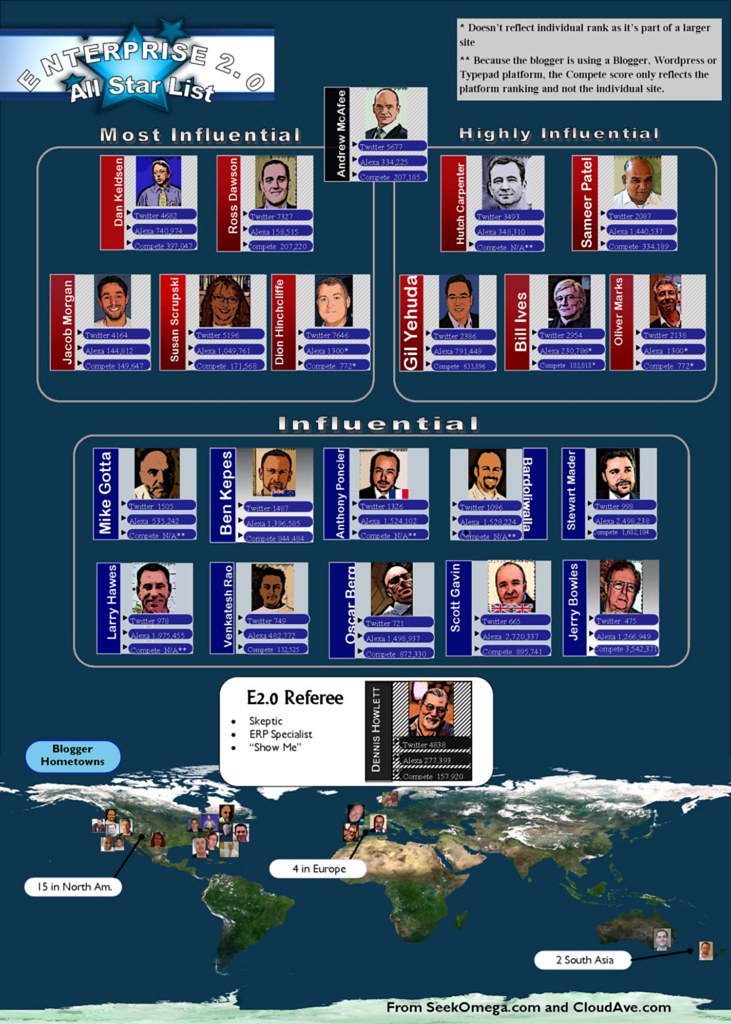
    The 2010 Enterprise 2.0 All-Star Blogger Roster

    Now that the holiday hangover has worn off and the bills are coming due, I want to turn your attention to the individuals that are most influencing the Enterprise 2.0 space.  Those of you that are early adopters or just starting to research Enterprise 2.0 can short cut the search for quality information by following and reading from these all-stars.

    How and why were these people chosen?  By a combination of influence and focus on Enterprise 2.0.  Some highly influential bloggers like Chris Brogan, Fred Zimny and Jeremiah Owyang were not chosen because their focus is outside the E2.0 space.  Sure they have an opinion on E2.0, but their primary focus is not on E2.0. 

    You’ll notice I’ve included Dennis Howlett.  In my opinion, he’s doing us a favor by pointing out the gaps in our claims and the flaws in our products.  We made him a E2.0 Referee because he’s never afraid to call foul.  In fact, we need more referees like him that keep the industry from going out of bounds.

    If you want to follow these individuals on Twitter I recommend the following Twitter lists by WebTechman, Sameer Patel and Hutch Carpenter.

    And now the list: <Hint: you’ll need to click to enlarge>

    Enterprise 2.0 all star blogger list

    The text version with links is below:

    Dion Hinchcliffe
    Twitter: 7646 
    Alexa: 1300*
    Compete: 772*
    Washington DC
     Ben Kepes
    Diversity.net & Cloud Ave
    Twitter: 1487
    Alexa: 1,396,585
    Compete: 844,484
    New Zealand
     Scott Gavin
    Twitter: 665
    Alexa: 2,720,337
    Compete: 895,741
    Kent, UK
     Jerry Bowles
    Twitter: 475 
    Alexa: 1,266,949
    Compete: 3,542,371
    New York
     Sameer Patel
    Pretzel Logic
    Twitter 2087
    Alexa: 1,440,537
    Compete: 334,189
    Palo Alto, CA
     Andrew McAfee
    Twitter: 5677
    Alexa: 334,225
    Compete: 207,185
    Boston, MA
    Bill Ives
    Fast Forward Blog
    Twitter: 2954
    Alexa: 230,786*
    Compete: 103,018*
    Boston, MA
     Venkatesh Rao
    Enterprise 2.0 Blog
    Twitter: 749
    Alexa: 482,772
    Compete: 132,525
    Arlington, VA

    Gil Yehuda
    Gil Yehuda's Enterprise 2.0 Blog
    Twitter: 2386
    Alexa: 791,449
    Compete: 633,896
    Boston, MA

     Jacob Morgan
    Twitter: 4164
    Alexa: 144,812
    Compete: 149,647
    San Francisco, CA
     Ross Dawson
    Trends in the Living Networks
    Twitter: 7327 
    Alexa: 158,515
    Compete: 207,220
    Sydney, Australia
    Oliver Marks
    Collaboration 2.0
    Twitter: 2138
    Alexa: 1300*
    Compete 772*
    San Francisco, CA
    Hutch Carpenter
    I’m actually not a Geek
    Twitter Followers 3493
    Alexa: 348,310
    Compete: N/A**
    San Francisco, CA
    Stewart Mader
    Future Changes
    Twitter: 998
    Alexa: 2,484,238
    Compete: 1,602,104
    San Francisco, CA
    Oscar Berg
    The Content Economy
    Alexa: 1,498,937
    Compete: 872,330
    Twitter: 721
    Lund, Sweden
     Dan Keldsen
    Twitter: 4682 
    Alexa: 740,974
    Compete: 397,047
    Boston, MA
    Susan Scrupski
    The ITSinsider
    Twitter: 5196
    Alexa: 1,049,761
    Compete 171,568
    Austin, TX
    Mike Gotta
    Collaborative Thinking
    Twitter: 1,505 
    Alexa: 535,242
    Compete: N/A**
    Connecticut
    Larry Hawes
    Together We Can
    Twitter: 978
    Alexa: 1,975,455
    Compete: N/A**
    Ipswich, MA

    Nenshad Bardoliwalla

    Strategy Driven Execution

    Alexa: 1,528,224

    Compete: N/A**

    Twitter: 1096

    Castro Valley, CA

    Anthony Poncier

    Blog d'Anthony Poncier

    Twitter: 1326
    Alexa: 1,524,102
    Compete: NA** 
    Paris France
      Dennis Howlett
    AccMan & Irregular Enterprise
    Twitter: 4838
    Alexa: 277,393
    Compete:157,920
    Alcaudete – where the hell is that?  Spain? .
     

    * Combined with other bloggers

    ** Because the blogger is using a blogger, wordpress or typepad platform, the Compete score only reflects the platform ranking and not the individual site.

    Did we miss anyone?  Please share in the comments below!

    Sunday, January 3, 2010

    Watch the New Year Saboteurs

    At the beginning of every new year, executives and managers are given new budgets to spend and initiatives to carry out.  Getting your team to buy into the initiatives is challenging especially when they go against the corporate grain.  image

    I experienced this as a young executive at a manufacturing organization.  Over the past decade, the 100+ sales team witnessed numerous initiatives that started in marketing, sales or R&D then simply died away without any explanation.  Being new, I did not understand the history and was surprised to see resistance to my ideas.  These ideas were going to pay the sales people more and increase sales.  Yet they still resisted or were apathetic at best.

    The typical management style of delegating responsibility to direct reports was not working. I needed to do something different and fast.  My job depended on it. 

    I started holding weekly workshops with my direct reports and staff to understand their resistance. I soon learned that previous executives that tried to implement new ideas were quickly shown the door.  They were kicked out because they didn’t get buy-in from their peers and their staff. 

    So naturally my staff wondered why this situation would be any different.

    I also perceived the issue was more than just failed initiatives.  I got the sense that there were a number of saboteurs that enjoyed watching executives fail.  The culture of the organization was mired in a malaise of dysfunction. 

    So did I leave?  Candidly I wanted to.  But I didn’t.  I took it on as a challenge.  Perhaps out of ignorance. 

    I mapped out the team into three categories.  The first group were the Allies who wanted change and were enthusiastic about the new vision.  They represented about 10% of the team.  The 2nd group were the Fence Sitters who were waiting for the situation to work out or implode.  They represented about 60% of the team.  Last were the saboteurs.  They represented the remaining 30% of the team. 

    My natural inclination was to focus on the Saboteurs.  To neutralize them or even fire them.  At the time, firing them would have been politically dangerous since most of them had been with the organization for 10+ years and were well connected.  Neutralizing them seemed impossible given their extreme cynicism.  Like a black hole, it would have sucked up all of our energy. 

    Instead I rallied the Allies to generate traction and show some early wins.  They were also more than willing to provide feedback for fine-tuning and improving the initiative implementations. 

    Yet it was hard.  Imagine gaining 20 yards on a football pass play only to have the front line penalized for tripping and the receivers for interference.  It was a series of small victories and frustrating set backs. 

    The Saboteurs were pulling every dirty trick imaginable.  It was a game of dodgeball and my own team was throwing the balls at me.

    But the tide started to turn when the Fence Sitters started to see success (however limited).  A critical mass began to form and the number of Allies increased.  This amplified the wins and the rest of the organization started to take notice.   At the end of the year, most of our new year’s initiatives were carried out (with mixed results) and we had won the majority over. 

    In spite of the success, I never completely won over the Saboteurs.  To them I was an outsider who wasn’t around for the early building years.   Yet we learned to coexist and over time their adversarial mind-sets slowly eroded. 

    Without their proactive interference, new projects were not as challenging and the Ally majority became optimistic about starting and completing their own initiatives.  

    While this was an extreme situation, there are always people that will want you to fail.  They don’t like you or your project.  Focus on your Allies.  Support and tell them how much you appreciate them.  Let them define the initiatives with you and you’ll receive the buy-in necessary to win over the fence sitters.    

    You win by incrementally gaining your team’s and organization’s trust. You win by winning.